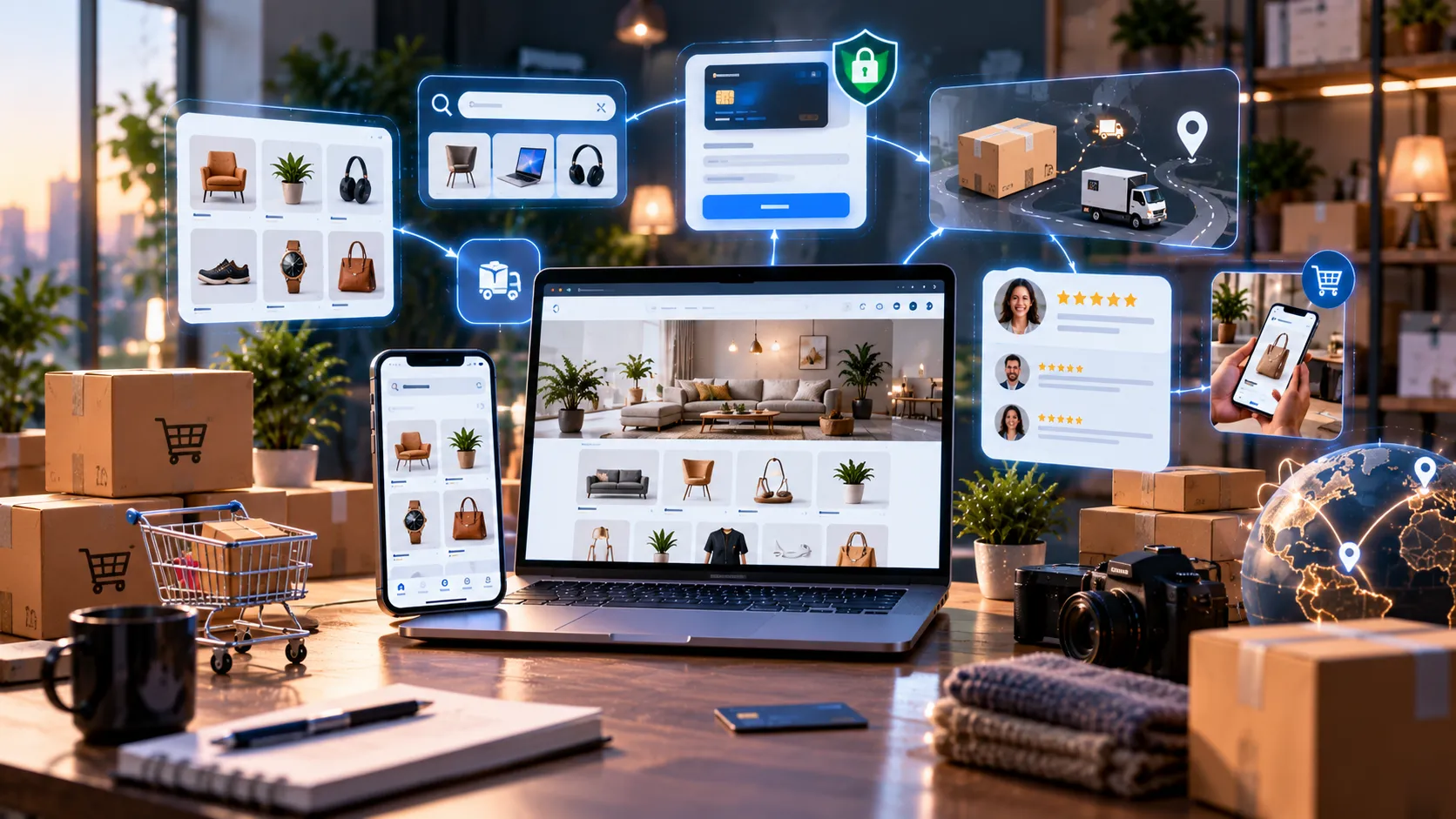
An ecommerce website's cost depends on the platform you choose, how large and complex your catalogue is, how custom the design is, what systems you integrate, and the ongoing fees that continue after launch. A small store on a hosted platform with a standard theme is a modest project; a custom-designed store with complex pricing, many integrations and a large catalogue is a much bigger one. The figures below are broad market ranges to help you plan a budget, not quotes.
The main cost drivers
| Driver | Lower cost | Higher cost |
|---|---|---|
| Platform | Hosted platform, standard theme | Open-source or custom build |
| Design | Adapted theme | Fully bespoke storefront |
| Catalogue | Few dozen simple products | Thousands of variants, complex options |
| Pricing rules | Fixed prices | Tiered, B2B, region-specific |
| Integrations | Payments only | ERP, inventory, accounting, shipping, POS |
| Content | You supply copy and images | Photography, copywriting, product data entry |
Platform choice sets the baseline
A hosted platform trades a monthly fee for handling hosting, security and updates, and gets a small store live quickly. An open-source platform has lower licensing cost but you pay for hosting, extensions and maintenance. A custom build is only justified by requirements the platforms cannot meet. See Shopify store setup and WooCommerce setup.
Design and theme
A well-chosen theme with your branding applied is efficient and effective for most stores. A bespoke storefront design costs more and is worth it when the shopping experience itself is a differentiator or the catalogue needs unusual presentation.
Catalogue setup
Entering products — descriptions, images, categories, options, stock, SEO fields — is real work that scales with catalogue size. Budget for it explicitly, or for a product upload service if you have hundreds of items.
Payments, shipping and tax
Every store configures a payment provider, shipping rules and tax handling. These are often where a “simple” store turns complex — multiple carriers, international rates, tax rules by region. See payment gateway integration.
Integrations
Connecting the store to inventory, accounting, an ERP, a POS or a fulfilment provider adds cost per integration. List these early — they are a frequent source of budget surprises.
Ongoing costs
- Platform subscription and transaction fees
- Hosting, if self-hosted
- Apps, extensions and plugins
- Maintenance, updates and security
- Marketing — SEO, ads, email — to bring traffic
How to budget
Work from your expected order volume and average order value to a realistic revenue figure, then decide how much store investment that justifies. Get comparable quotes on the same scope, and check what support after launch is included.
Frequently asked questions
Is a hosted platform or a custom store cheaper?
A hosted platform is almost always cheaper to build and run for a standard store. A custom build only makes financial sense when platform limitations would cost you more in workarounds or lost sales than the build costs.
How long does an ecommerce site take to build?
A small store on a hosted platform can launch in a few weeks. Larger catalogues, custom design and integrations extend that to a few months.
What ongoing costs should I expect?
Platform fees, transaction fees, apps or plugins, maintenance, and marketing. Marketing is often the largest ongoing cost and the one most underestimated.
Can I start small and expand?
Yes, and it is usually the right approach: launch a focused store, prove demand, then invest in design, integrations and catalogue depth as sales justify it.
Planning an online store
Tell us your catalogue, volume and any systems to connect. We will recommend a platform and give you a realistic budget.